Import Video into Descript Step by Step
Sep 26, 2026
Direct answer: To import a video file into Descript, open a project and bring the clip in one of three ways: drag the video onto the project, use the Upload / plus control in the Project panel, or drop it into an empty composition. The clip lands in your Files list—then add it to the script (to transcribe) or drop it on the canvas as a layer.
This is the video-file walkthrough from the Descript Made Easy lesson “Importing Media” (Core Skills / Importing & Using Media), plus official Descript help on local upload and supported types. For the broader media overview (images and audio too), see Importing Media in Descript: Beginner Guide. Audio-focused import gets its own post next.
This article was written with AI, based on a real Descript Made Easy lesson by the humans behind Descript Made Easy.
How do I import a video file into Descript step by step?
Pick the path that feels simplest. All three get the same result for a video: your clip in the project’s Files list.
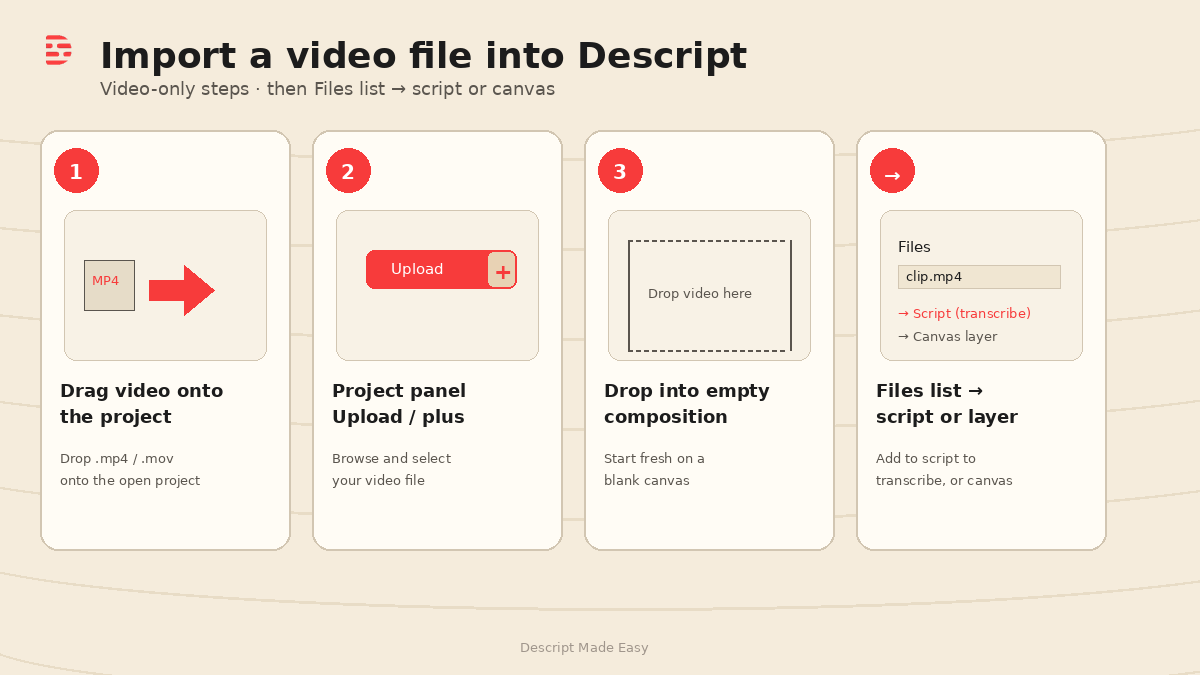
Three ways to bring a video file in, then use the Files list to add it to your script or canvas.
Watch: Easiest Way to Add Your Own Media to Descript
This clip from Descript Made Easy with Ross pairs with the video-import steps below:

Watch on YouTube: Easiest Way to Add Your Own Media to Descript — then practice with one of your own video files. (The full course lesson “Importing Media” is also inside Descript Made Easy.)
Step-by-step: import a video file
- Open a Descript project (or create a new one).
- Locate your video file on your computer (common containers include MP4, MOV, M4V, and others listed in Descript Help).
- Choose one import path for that video:
- Drag and drop the video from Finder (Mac) or File Explorer (Windows) onto the open project, or
- Open the Project panel (right sidebar) and use the Upload / plus control to browse and select the video, or
- Drop the video into an empty composition if you are starting on a blank canvas.
- Wait for the upload to finish. Watch progress in the Activity panel if Descript shows it (official help).
- Confirm the clip appears in the Files list in the Project panel.
- From Files, either add it to the script (so Descript can transcribe the speech) or drop it on the canvas as a layer (visuals / B-roll style use).
- Play back a few seconds to confirm the video imported cleanly.
Official walkthroughs: Import and upload files into Descript and Upload a file from your computer.
Where does my video land after I import it?
Imported video lives in the Files section of the Project panel. From there you can add it to the script, place it as a layer on the canvas/timeline, or open the file menu for more options. Uploading stores the media in the project; adding to the script is what kicks off transcription for spoken video.
Can I drag already-organized folders from the desktop into Descript?
This lesson walks through importing individual files (drag a file onto the project, Upload/plus, or drop into an empty composition)—not whole desktop folders as a single import action. Keep your video files where you can find them, then bring in the clips you need one file (or a multi-select of files) at a time via those paths. If you want a folder-style organization inside Descript later, start from the Files list after import rather than assuming a desktop folder drag is the lesson path.
What video file types work?
Stick to formats you already shoot with. Descript Help lists common video containers such as MP4, M4V, MOV, WEBM, MKV, and MXF (with supported codecs like H.264 and HEVC). Check Supported file types before you hunt for exotic codecs. For a plain-language MP3/MP4/MOV walkthrough, see our related file-types post linked below.
Do I need to transcribe after I import video?
Importing puts the video in Files. If you want text-based editing, add the clip to the script so Descript can transcribe the speech. Dropping it only as a canvas layer does not replace that step. For a fuller import-plus-transcribe tutorial, see How to Import and Transcribe Video in Descript (2026 Tutorial)—this post stays focused on getting the video file in.
Get the printable Import video into Descript checklist
Want a one-page checklist you can print and tick off while you practice importing a video? Enter your email below—button copy is Get the checklist. Feel free to print it.
FAQ
How do I import a video into Descript?
Open a project, then drag the video onto the project, use Project panel Upload/plus, or drop it into an empty composition. Confirm it in Files.
Where does imported video show up?
In the Files list in the Project panel (right sidebar).
How do I transcribe after importing video?
Add the file to the script so Descript can transcribe the speech.
What video file types does Descript accept?
Common video containers and codecs (for example MP4/MOV with H.264/HEVC). See Descript Help: Supported file types for the current list.
Is this different from the Importing Media beginner guide?
Yes. That overview covers media in general. This post is the video-file step-by-step only.
Where should I go next as a beginner?
Use the Descript for Beginners hub, skim file types, then practice one short video import + light edit.
Keep learning
- Descript for Beginners
- Importing Media in Descript: Beginner Guide
- How to Import and Transcribe Video in Descript (2026 Tutorial)
- File Types Explained: MP3, MP4, MOV, and What Descript Accepts
- Transcript, Scene Editor, and Timeline: Descript Editor Map
- Creating Your First Video Project in Descript
- Descript Help: Import and upload files
- Descript Help: Upload a file from your computer
- Free getting-started class
- Descript Made Easy
Want live help while you learn? Join the free 1-hour class: https://www.descriptmastery.com/getting-started-with-descript
Or go straight to Descript Made Easy: https://www.descriptmastery.com/
Check out the Descript Mastery School - my step-by-step blueprint for creating beautiful videos in 25% of the time.
Get 🔥 Descript tips!
Receive Descript tips, free resources, and easy-to-follow tutorials by email.
We hate SPAM. We will never sell your information, for any reason.