Roll Back a Bad Edit with Descript Version History
Sep 22, 2026
Direct answer: When a stretch of edits goes wrong in Descript, open ☰ → File → Version History, click View on an earlier snapshot (about every 10–15 minutes), then Restore after you read the warning. Restoring rolls the whole project back—not just one composition. Use Undo (or reveal deleted media) only for small, same-session slips.
This recovery walkthrough is grounded in the Descript Made Easy lesson “Don’t Fear Mistakes! - Version History and Undo” (Core Skills / Create Your First Project) and official Descript help on version history. For a broader overview of Undo vs Version History, see the companion beginner guide linked below.
This article was written with AI, based on a real Descript Made Easy lesson by the humans behind Descript Made Easy.
When should I roll back with Version History instead of Undo?
Undo (top-left arrow, Edit → Undo, or Cmd/Ctrl+Z) is perfect for the last action—and you can keep undoing in the same session. It resets if you refresh or leave Descript. Version History is the recovery path when:
- You’ve been editing for hours (or days) and the project went sideways.
- Undo can’t reach far enough because the session stack is gone.
- You want to preview how the project looked at a past moment before committing to a rollback.
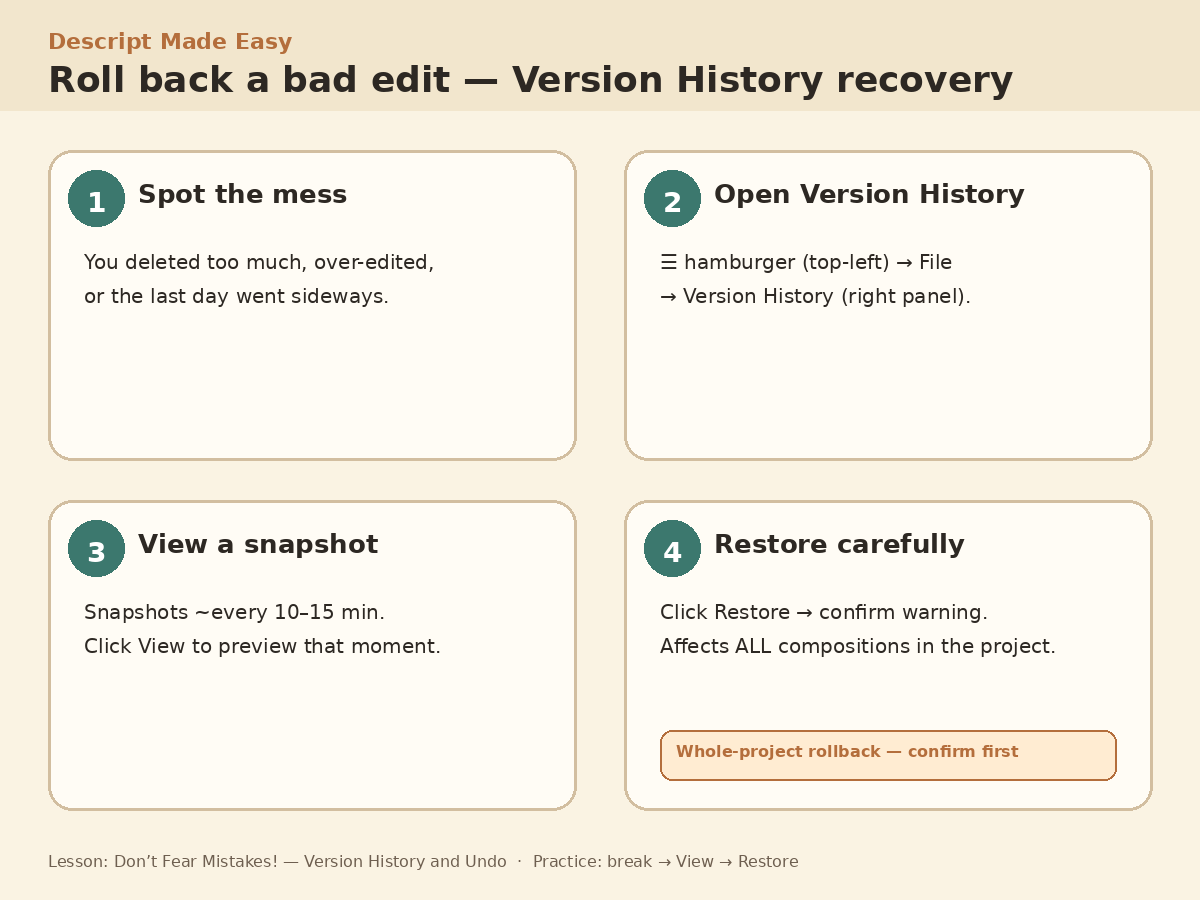
Recovery path: spot the mess → open Version History → View a snapshot → Restore only after the whole-project warning.
Watch: Restore Deleted Text or Old Versions
This clip from Descript Made Easy with Ross shows restoring old versions—pair it with the steps below:

Watch on YouTube: Restore Deleted Text or Old Versions — then run the practice drill at the end. (The full lesson video is also inside Descript Made Easy.)
How do I roll back a bad edit with Version History?
- Open the project that needs recovering.
- Click the hamburger menu (☰) in the top-left.
- Choose File → Version History. A chronological log opens on the right.
- Remember: Descript saves snapshots roughly every 10–15 minutes—not every keystroke—so pick the timestamp closest to “before things went wrong.”
- Click View next to a revision to preview how the project looked then (cuts, transcript, everything at that moment).
- If that preview is where you want to work again, click Restore.
- Read the confirmation warning, then confirm only if you accept undoing everything between now and that snapshot.
Critical: restoring a version affects all compositions and files in the project—not only the composition on screen. See Descript Help: Version history.
What if I only deleted one section—do I need Version History?
Often no. Descript is a nondestructive editor: a delete usually covers part of the underlying source instead of destroying it. Grab the bracket on the transcript or timeline and drag to reveal the covered portion. That recovers a local cut without rolling the whole project back. Save Version History for bigger messes.
What if I messed up my project—can I go back?
Yes—that is the call-bank question this recovery path answers. Tiny slip same session → Undo. Cut too much locally → reveal with the bracket. Last day (or two) went sideways → Version History → View → Restore, knowing it is a whole-project rewind.
Practice drill: break something, then recover
- On purpose, delete a chunk or make a messy edit.
- Undo it once so you feel the session Undo path.
- Make another mess (or leave and come back so Undo resets).
- Open Version History, View an earlier snapshot, then Restore if you want that state back.
Doing the scary thing once—on purpose—removes the fear of experimenting.
Get the printable Version History recovery checklist
Want a one-page recovery checklist you can print and tick off while you practice? Enter your email below—button copy is Get the checklist. Feel free to print it.
FAQ
How do I open Version History in Descript?
Top-left hamburger menu → File → Version History. The list appears on the right.
How often does Descript save versions?
Roughly every 10–15 minutes as you work (lesson guidance)—not after every micro-edit.
Does Restore affect only one composition?
No. Restoring affects all compositions and files in the project. Confirm carefully.
When should I use Undo instead of Restore?
For the last action(s) in the same session. After refresh or leaving, use Version History or reveal deleted media.
Can I preview before I restore?
Yes. Click View on a snapshot first. Only click Restore when that preview is the state you want.
What if I messed up my project—can I go back?
Yes. Use Undo or reveal for small slips; use Version History View + Restore for larger rollbacks.
Where should I go next as a beginner?
Use the Descript for Beginners hub, keep practicing the editing cycle, then continue with a free class or Descript Made Easy.
Keep learning
- Descript for Beginners
- Don’t Fear Mistakes: Version History and Undo in Descript (Beginner Guide)
- The Editing Cycle in Descript: Beginner Guide
- Rough Cut to Final Cut Using the Editing Cycle
- Ten Descript Hotkeys That Save the Most Time
- Setting Aspect Ratio in Descript: Beginner Guide
- Descript Help: Version history
- Free getting-started class
- Descript Made Easy
Want live help while you learn? Join the free 1-hour class: https://www.descriptmastery.com/getting-started-with-descript
Or go straight to Descript Made Easy: https://www.descriptmastery.com/
Check out the Descript Mastery School - my step-by-step blueprint for creating beautiful videos in 25% of the time.
Get 🔥 Descript tips!
Receive Descript tips, free resources, and easy-to-follow tutorials by email.
We hate SPAM. We will never sell your information, for any reason.